Break-even analysis is a financial tool that helps businesses determine the point at which their revenue equals their total costs. This point, known as the break-even point (BEP), signifies that the company is neither making a profit nor incurring a loss. Understanding the BEP is crucial for making informed decisions about pricing, production levels, and overall business strategy. A break-even analysis template provides a structured way to calculate and analyze this critical metric.
What is a Break-Even Analysis Template?
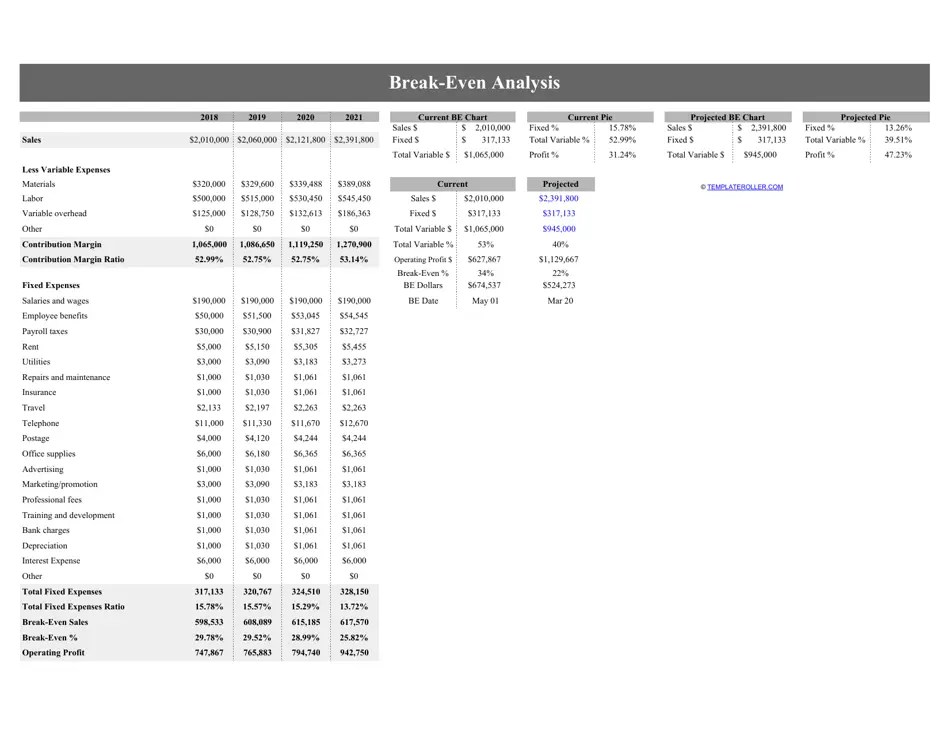
A break-even analysis template is a pre-designed document, usually in the form of a spreadsheet or a dedicated software program, that simplifies the process of calculating the break-even point. It provides a framework for organizing the necessary data and applying the break-even formula. The template typically includes designated cells or fields for inputting fixed costs, variable costs per unit, and selling price per unit. Once these values are entered, the template automatically calculates the break-even point in units and/or sales revenue.
Components of a Break-Even Analysis Template
A comprehensive break-even analysis template usually incorporates the following elements:
- Fixed Costs: These are costs that remain constant regardless of the production volume. Examples include rent, salaries, insurance premiums, and depreciation. The template should allow for the input of various fixed costs and calculate the total fixed costs.
- Variable Costs: These are costs that fluctuate directly with the level of production. Examples include raw materials, direct labor, and packaging. The template needs a field to enter the variable cost per unit produced.
- Selling Price per Unit: This is the price at which each unit of the product or service is sold. The template requires this value to calculate total revenue.
- Break-Even Point in Units: This is the number of units that must be sold to cover all costs. It is calculated using the formula: Fixed Costs / (Selling Price per Unit – Variable Cost per Unit). The template automatically performs this calculation.
- Break-Even Point in Sales Revenue: This is the total revenue required to cover all costs. It can be calculated by multiplying the break-even point in units by the selling price per unit, or directly using the formula: Fixed Costs / ((Selling Price per Unit – Variable Cost per Unit) / Selling Price per Unit), which simplifies to Fixed Costs / Contribution Margin Ratio. The template usually provides this calculation as well.
- Contribution Margin: The contribution margin represents the amount of revenue that contributes to covering fixed costs and generating profit. It is calculated as: Selling Price per Unit – Variable Cost per Unit. Some templates explicitly display the contribution margin.
- Contribution Margin Ratio: The contribution margin ratio is the percentage of revenue that contributes to covering fixed costs and generating profit. It is calculated as: (Selling Price per Unit – Variable Cost per Unit) / Selling Price per Unit.
- Margin of Safety: The margin of safety indicates the amount by which sales can decline before the business starts incurring losses. It’s calculated as: (Actual Sales – Break-Even Sales) / Actual Sales. It can be expressed in units or revenue. While not always included, a margin of safety calculation enhances the template’s usefulness.
- Graphs and Charts: Some templates incorporate visual representations of the break-even analysis, such as a break-even chart. This chart typically plots total revenue, total costs, and fixed costs against the number of units sold, visually highlighting the break-even point.
Benefits of Using a Break-Even Analysis Template
Employing a break-even analysis template offers several advantages:
- Efficiency: The template streamlines the calculation process, saving time and effort compared to manual calculations.
- Accuracy: By using predefined formulas, the template reduces the risk of calculation errors.
- Scenario Planning: Templates facilitate “what-if” analysis. Users can easily adjust input variables (e.g., selling price, variable costs) to assess the impact on the break-even point. This is invaluable for evaluating different pricing strategies or cost-reduction measures.
- Improved Decision-Making: Understanding the break-even point provides crucial insights for making informed decisions about pricing, production volume, and investment opportunities.
- Financial Planning: The break-even analysis can be integrated into a comprehensive financial plan, helping businesses set realistic sales targets and manage expenses effectively.
- Investor Communication: A well-prepared break-even analysis can be presented to investors or lenders to demonstrate the viability of a business venture and its potential for profitability.
How to Use a Break-Even Analysis Template
Using a break-even analysis template is typically straightforward:
- Obtain a Template: Choose a template that suits your needs, either from a spreadsheet program (like Excel or Google Sheets) or a specialized financial analysis software. Numerous free templates are available online.
- Gather Data: Collect accurate data for fixed costs, variable costs per unit, and selling price per unit.
- Enter Data: Input the data into the designated cells or fields in the template. Ensure that the data is entered correctly and in the appropriate units (e.g., cost per unit, total fixed costs per month).
- Analyze Results: Review the calculated break-even point in units and sales revenue. Consider the implications of these values for your business.
- Conduct Scenario Analysis: Experiment with different values for selling price, variable costs, and fixed costs to assess the impact on the break-even point. This can help you identify potential risks and opportunities.
- Interpret and Apply: Use the results of the break-even analysis to inform your business decisions, such as setting pricing strategies, managing costs, and forecasting sales.
Limitations of Break-Even Analysis
While a valuable tool, break-even analysis has limitations:
- Assumptions: It relies on assumptions about fixed costs, variable costs, and selling price, which may not hold true in reality. Changes in market conditions or production processes can affect these variables.
- Linearity: It assumes a linear relationship between costs and revenue, which may not always be the case. For example, economies of scale can lead to lower variable costs per unit as production increases.
- Single Product Focus: It is most easily applied to businesses with a single product or service. For businesses with multiple products, a more complex analysis may be required.
- Static Analysis: It is a static analysis, meaning it provides a snapshot in time. It doesn’t account for changes in demand, competition, or other external factors.
Despite these limitations, a break-even analysis template remains a powerful tool for businesses of all sizes. By providing a clear understanding of the relationship between costs, revenue, and profitability, it empowers businesses to make more informed decisions and improve their chances of success.
 680×656 break analysis templates excel from www.template.net
  950×733 break analysis template fill sign from www.templateroller.com
  840×957 break analysis excel templates from exceltemplate.net
  768×1024 break analysis template templates word excel from www.formsbirds.com
  600×730 break analysis templates word excel formats from www.wordpdftemplates.com
  727×509 break analysis templates printable xlsx docs from www.excelstemplates.com


Tidak ada komentar:
Posting Komentar